The problem
Strategic coordination in UTM, deciding whose flight plan is approved, who lands first, and how shared resources are allocated, involves operators who compete with each other. A central coordinator that must know everyone’s private costs is both a privacy liability and a single point of failure. And participants may misreport, collude, or have their information spoofed.
Our approach
- No trusted center required. Purdue developed decentralized learning algorithms for leader-follower games in which operators reach a stable, efficient operating point from their own observations, with no one able to stall the system by withholding information.
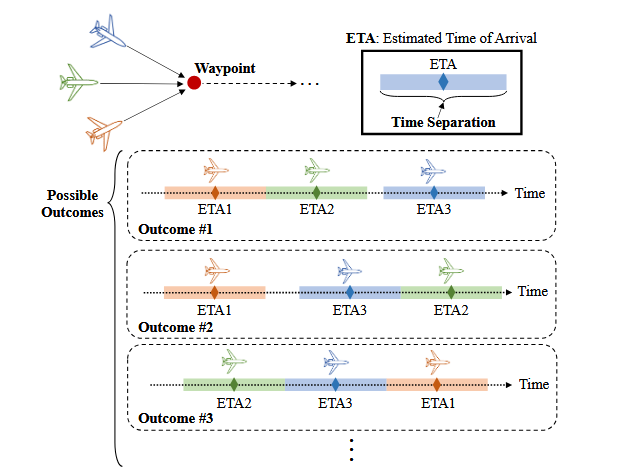
- Agreement without disclosure. UT Austin’s Trading Auction for Consensus lets aircraft agree on a safety-feasible arrival sequence without revealing private valuations, and game-theoretic coordination relieves sector overload at scale.
- Robust to untrusted information. UT Austin formulates vertiport sequencing that stays robust when reported arrival times may be strategically misreported or spoofed. Purdue detects collusion purely from observed actions.
- Fair by design. Purdue’s fair multi-user dueling bandits learn operator preferences online for strategic deconfliction, as an alternative to first-come, first-served.
- Distributed approval. Vanderbilt explored hashgraph-based consensus so mutually distrusting operators can agree on approved flight plans without a central authority.
Looking ahead
Purdue is designing a UTM use case for fair strategic conflict resolution, and the auction protocols are being extended with convergence guarantees.