The problem
In a busy city, several delivery companies may operate fleets with different aircraft, sensing ranges, and collision-avoidance logic in the same airspace. Every one of those tactical decisions depends on knowing where each aircraft is, and that knowledge comes from GPS, which can be degraded or spoofed.
Our approach
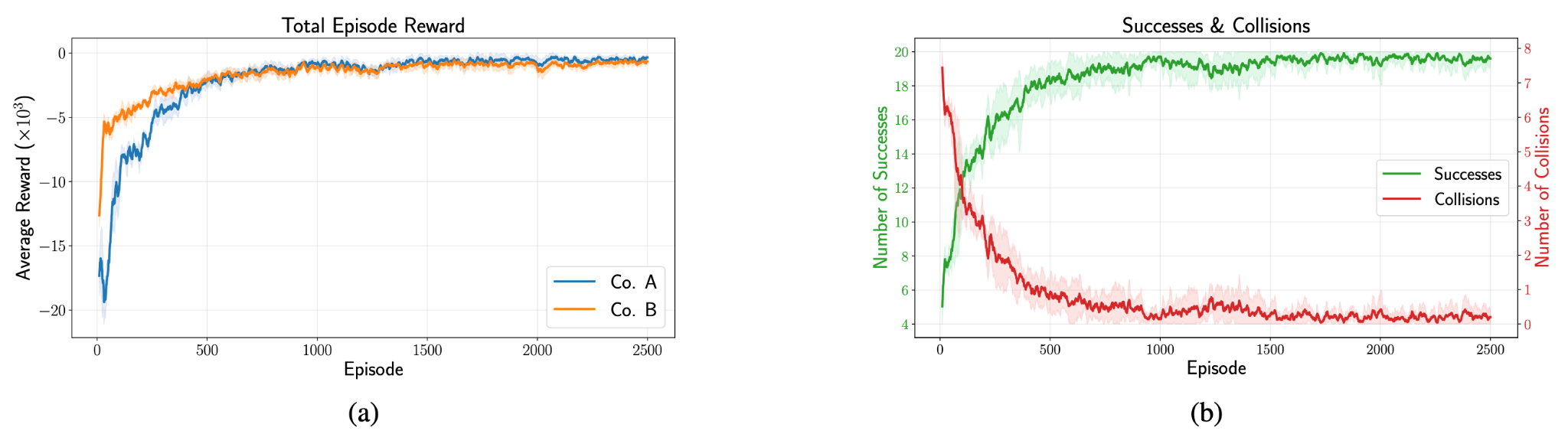
- Mixed fleets, shared sky. GWU and Purdue examined whether independently trained deconfliction policies from different companies converge to safe co-existence in a simulated delivery network over Frisco, Texas, in the Dallas area, and whether the outcome is fair to operators with less capable aircraft. Policies converged and collisions fell sharply, but stronger fleets were systematically favored.
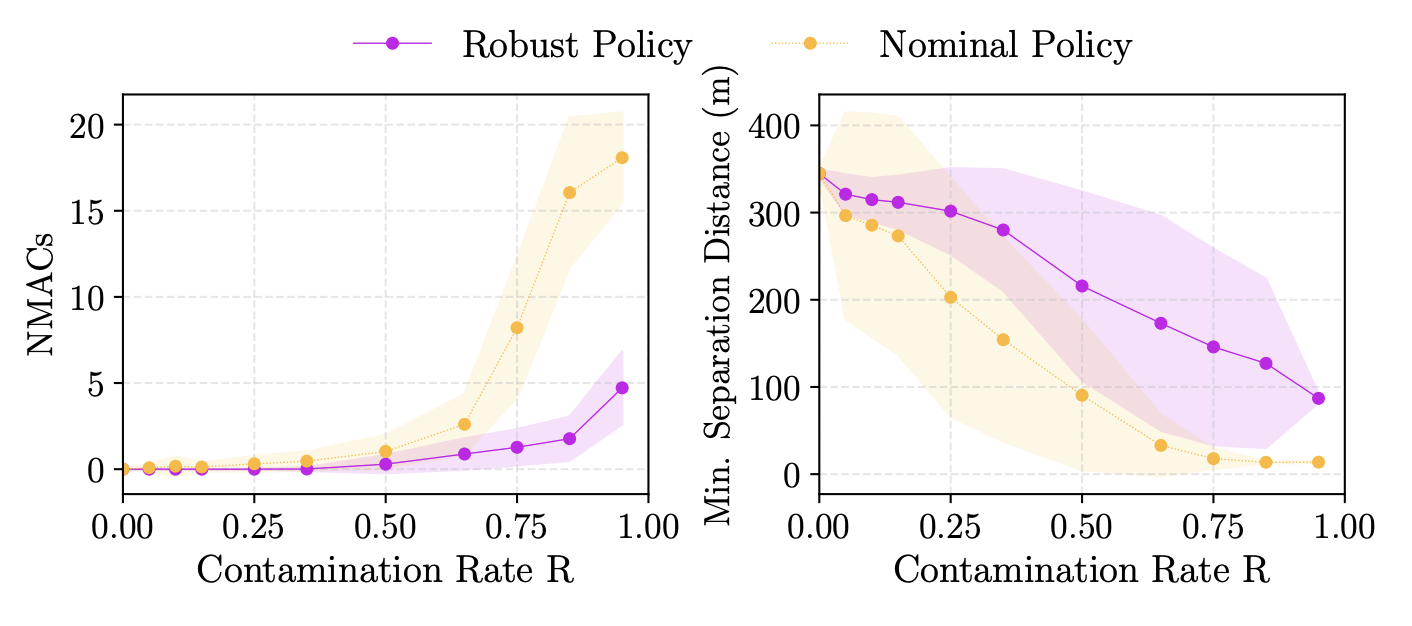
- Robust to corrupted GPS. GWU and UT Austin model GPS corruption as a game between aircraft and a spoofer, derive a closed-form worst-case perturbation for efficient adversarial training, and add runtime safety filtering that corrects the observation the policy sees.
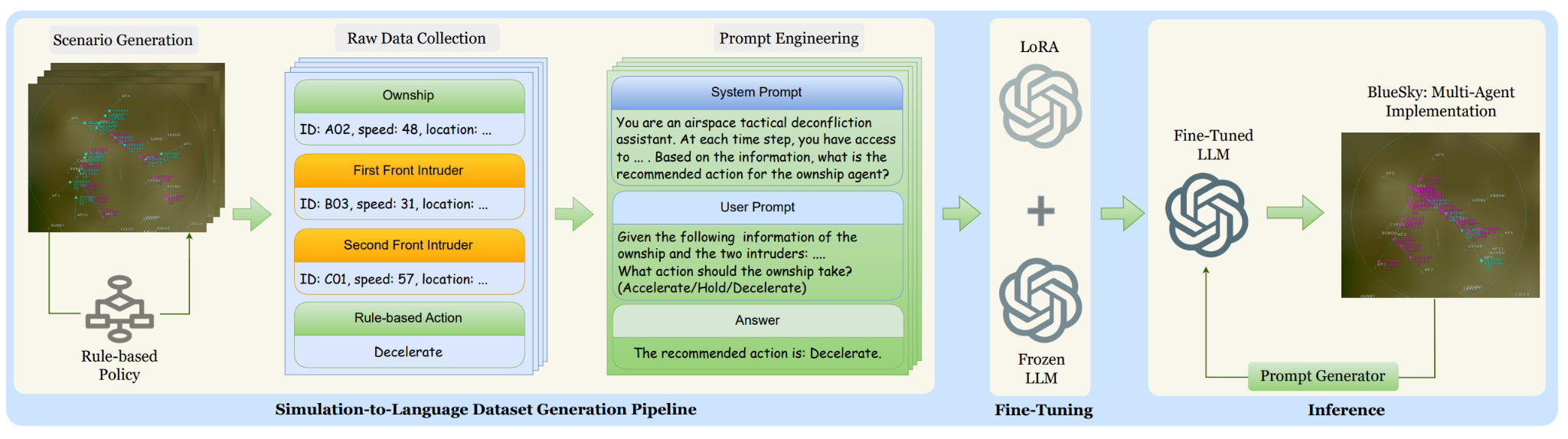
- Language models as interpretable policies. GWU built a simulation-to-language pipeline in the BlueSky simulator and fine-tuned an open language model to make tactical deconfliction decisions, reducing near mid-air collisions and raising mission completion in closed-loop tests.
Looking ahead
Ongoing work addresses inference latency, formal safety assurance, and benchmarking against rule-based and reinforcement-learning baselines, with demonstrations planned for Year 3.