Will the drop zone stay clear?
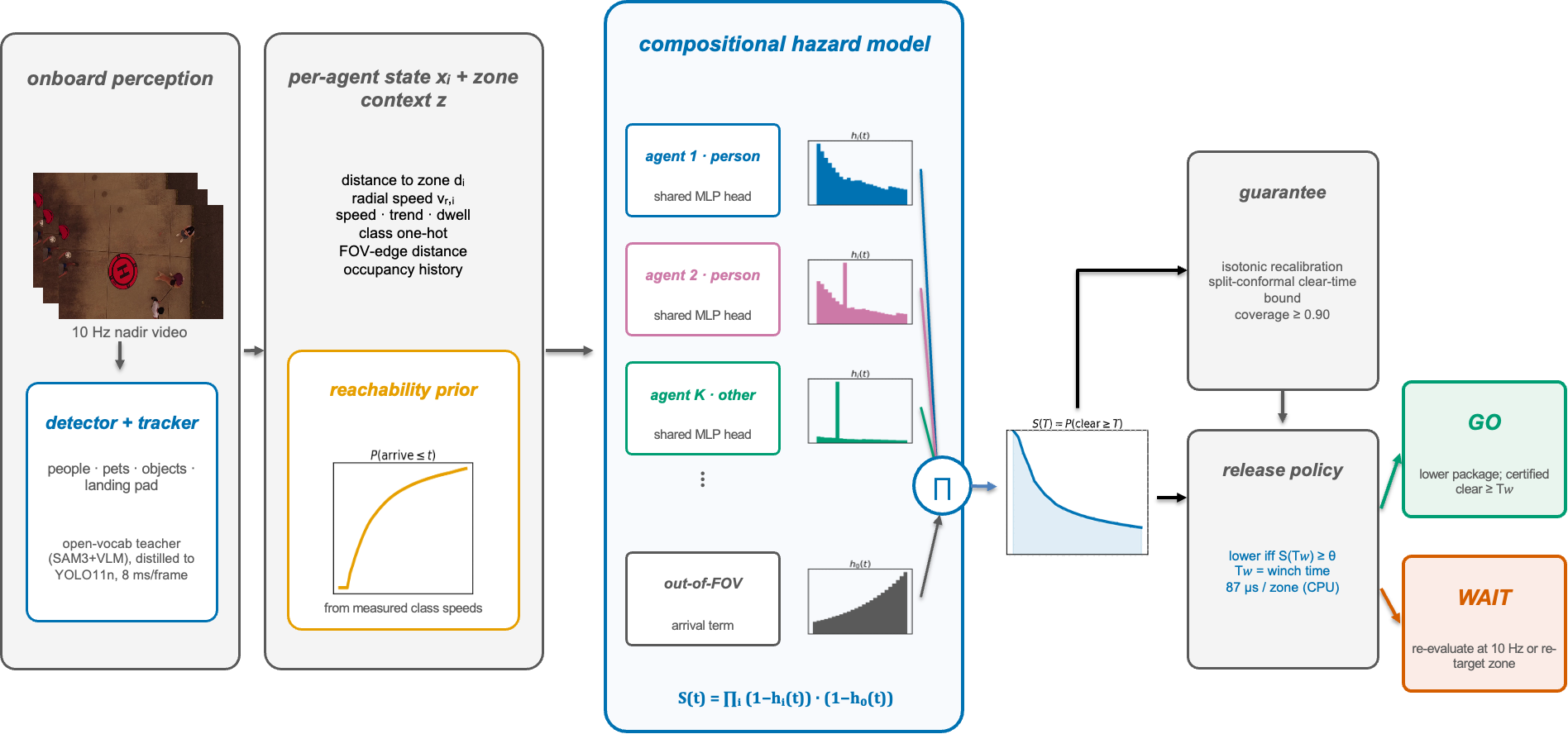
Overhead drone video of a delivery pad. GWU’s model tracks the people and objects around it, forecasts how long the zone will stay clear, and decides whether to lower the package, wait, or treat the zone as occupied.
GWU · Washington, DC
Lead institution. Perception-based drone delivery and landing, AI-based separation assurance, and the security of air traffic control voice communication.
The George Washington University is the lead institution; Principal Investigator Peng Wei leads the eight-institution team. GWU’s research covers aircraft separation assurance for small drones, including heterogeneous fleets, GPS degradation and spoofing, and language-model-based deconfliction; vision-based drone delivery and landing; and the security of air traffic control voice communication. GWU works with Purdue, TSU, UC Irvine, UT Austin, and NVCC, and hosts NVCC students as summer research interns.
Research thrusts
Benchmarked transformer and CNN detectors for safe autonomous landing with conformal uncertainty, used vision-language models to identify and explain safe landing zones, and is forecasting how long a drop zone will stay clear during tethered delivery.
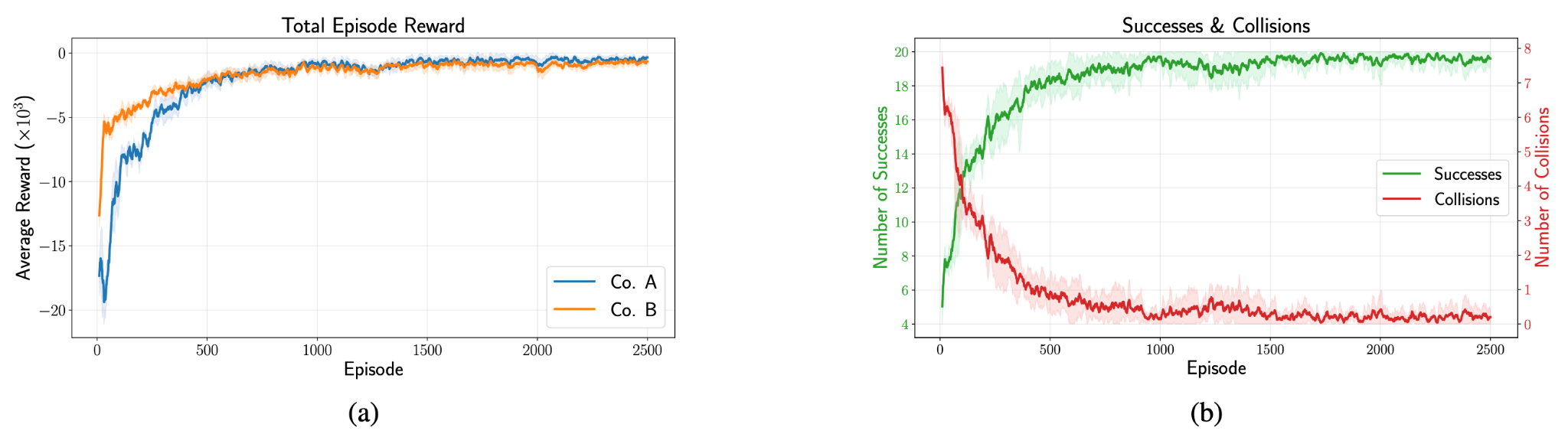
Showed that independently trained, attention-based deconfliction policies from different delivery companies can converge to safe co-existence, and analyzed whether the outcome is fair to less capable fleets.
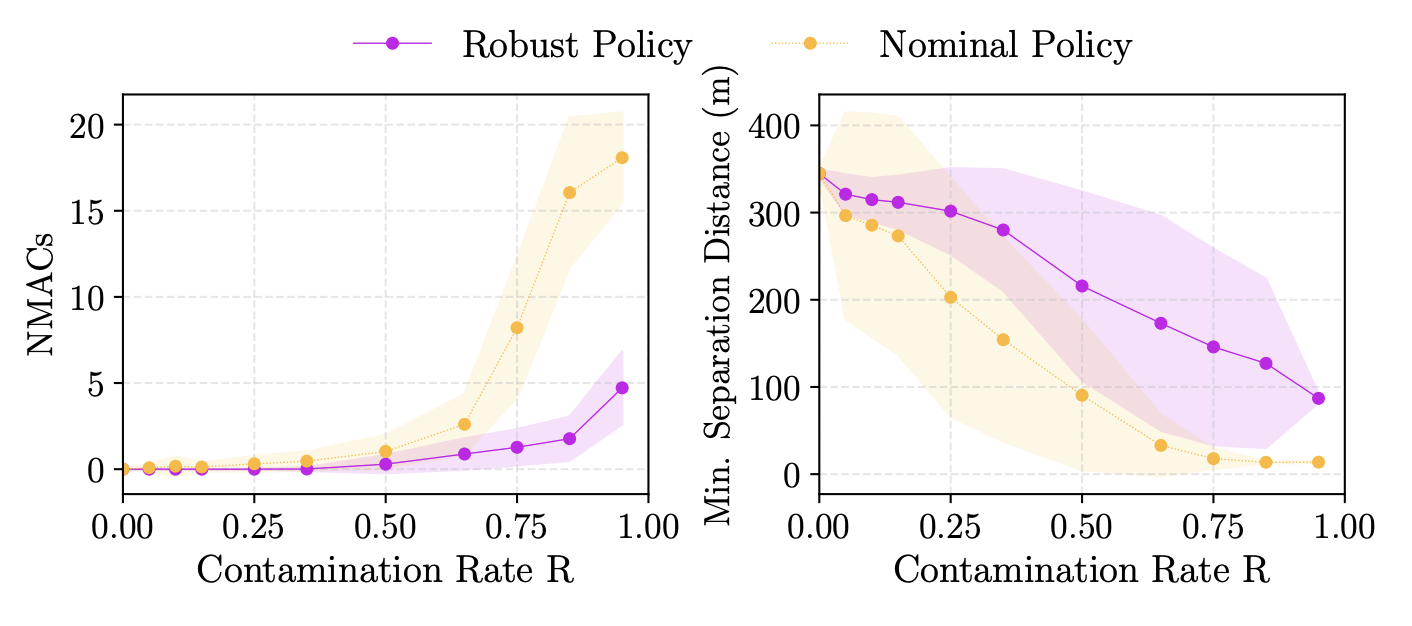
Robust multi-agent reinforcement learning that models GPS corruption as a zero-sum game, plus runtime safety filtering that protects learned policies during deployment.
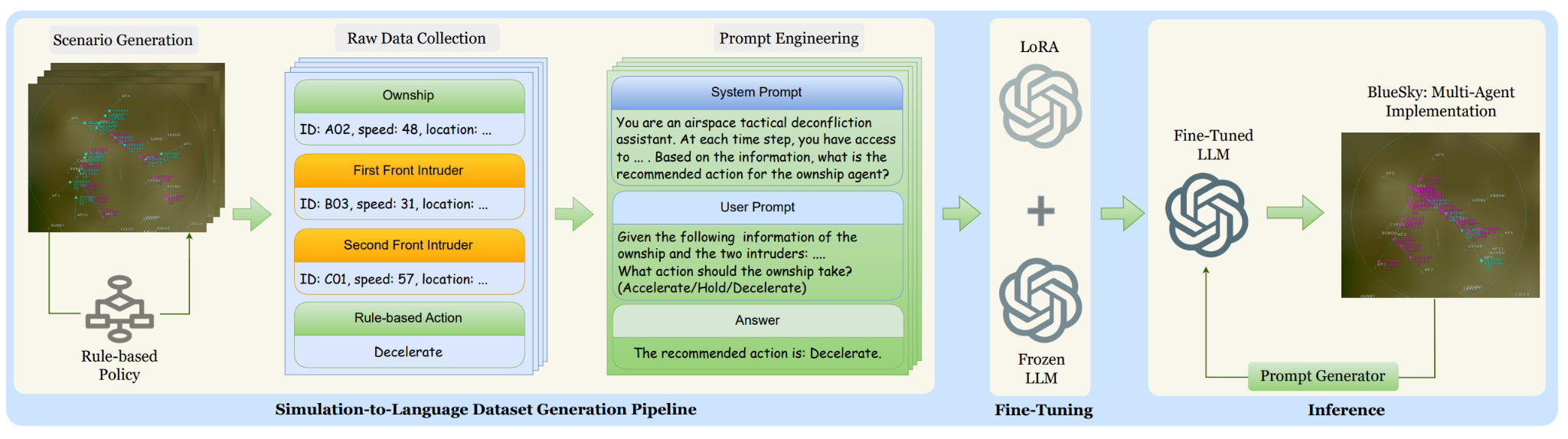
A simulation-to-language pipeline in BlueSky and a fine-tuned open language model that makes interpretable deconfliction decisions in closed-loop simulation.
A multidimensional evaluation of AI-synthesized controller speech, providing evidence for assessing the risk of unauthorized voice instructions.
Figures

Demos
Overhead drone video of a delivery pad. GWU’s model tracks the people and objects around it, forecasts how long the zone will stay clear, and decides whether to lower the package, wait, or treat the zone as occupied.
BlueSky simulation of drones from two delivery companies over Frisco, Texas, each fleet flying its own attention-based multi-agent reinforcement-learning deconfliction policy.
A fine-tuned large language model issues tactical deconfliction actions to drones in closed-loop BlueSky simulation.
A walkthrough of GridEye, the read-only traffic-management dashboard built by NVCC interns. It tracks a 12-drone delivery fleet over simulated Frisco, Texas, and flags flight-boundary, no-fly-zone, and altitude violations.
Use cases
Making camera- and AI-based package delivery and precision landing trustworthy, even when the scene below can be manipulated.
Physical adversarial objects, tampered landing markers, and injected visual text that mislead onboard perception.
Keeping drones from multiple operators safely apart when fleets, policies, and navigation data differ, or are corrupted.
GPS/GNSS degradation and spoofing, and unsafe interactions among heterogeneous fleets and collision-avoidance policies.
Assessing how convincingly AI speech synthesis can imitate controller instructions, to inform procedural and technical defenses.
Synthetic controller voices delivering unauthorized instructions over voice radio.
Evaluating and hardening the MAVLink link between ground control stations and drones, and detecting hijacked vehicles.
Interception, command injection, and telemetry spoofing on unauthenticated control links.
People
Publications
10 published or accepted papers
AIAA SciTech Forum, 2026
AIAA SciTech Forum, 2026
CVPR Workshop on Multi-Agent Embodied Intelligent Systems Meet Generative-AI Era (MEIS), 2026
Integrated Communications, Navigation and Surveillance Conference (ICNS), 2026
IEEE Conference on Decision and Control (CDC), 2026Accepted
AIAA/IEEE Digital Avionics Systems Conference (DASC), 2026
AIAA/IEEE Digital Avionics Systems Conference (DASC), Orlando, FL, 2026
IEEE International Conference on Intelligent Transportation Systems (ITSC), 2026
AIAA Aviation Forum, 2026
AIAA Aviation Forum, 2025