Cooperative collision avoidance
Three simulated drones in Gazebo maneuver around one another using their neighbors' broadcast positions. This is the cooperative behavior that Remote ID spoofing targets, and that spoofing-aware planning protects.
Vanderbilt · Nashville, TN
Networked multi-UAV simulation, Remote ID spoofing detection, and machine-learning anomaly detection for small unmanned aircraft.
Vanderbilt’s team, led by Bryan C. Ward with co-investigator Gautam Biswas, builds the project’s networked simulation platform for small UAS, which models multi-operator urban operations and generates cyberattack datasets. On this platform the team studies Remote ID spoofing attacks and defenses, from signal-based detection and spoofing-aware trajectory planning to an SDR-equipped drone for physical demonstration, and develops learning-based detection of MAVLink cyber anomalies. Vanderbilt collaborates with Collins Aerospace and UT Austin.
Research thrusts
An open-source distributed simulator integrating ArduPilot SITL, Gazebo, QGroundControl, and OMNeT++ that models multi-operator operations under the FAA UTM concept of operations, with a library of adversarial scenarios for cyberattack research.
Detectors that exploit the physics of the radio signal, from onboard filtering to federated multilateration and learned models, evaluated across 1,920 simulated urban scenarios.
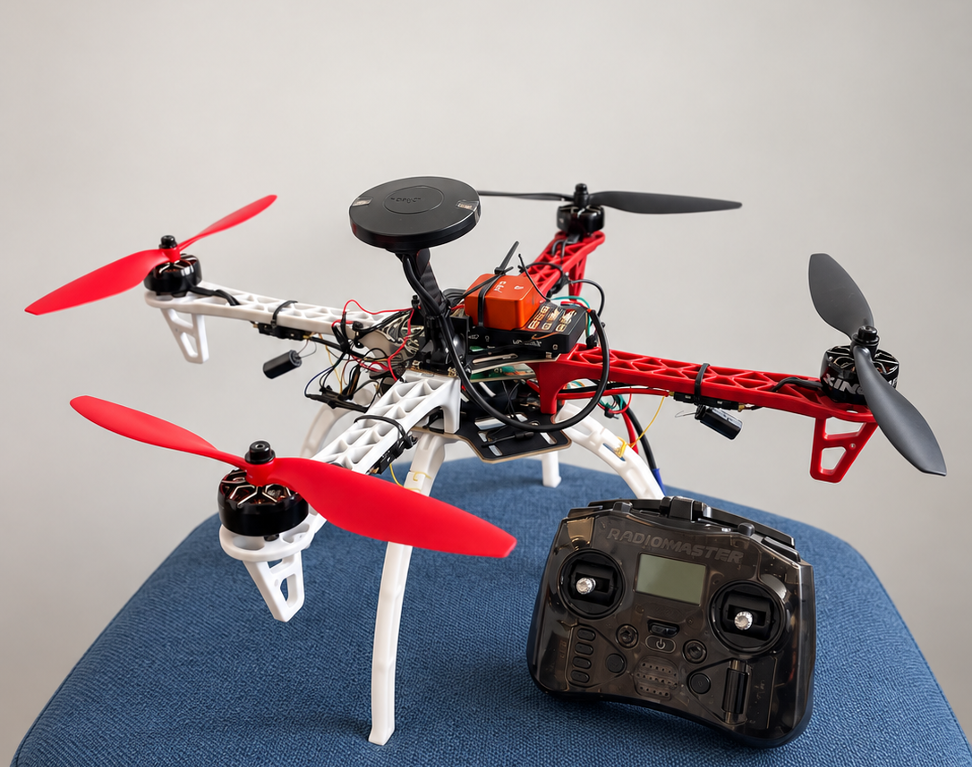
A small UAS testbed with a software-defined radio that adds Doppler shift and angle-of-arrival checks to validate detection in real RF environments.
Decentralized planning that treats Remote ID as unverified, localizes a suspected spoofer under uncertainty, and avoids a chance-constrained unsafe region.
Graph learning that detects compromised drones under tight communication budgets, and detectors trained on attack datasets generated with the networked simulator.
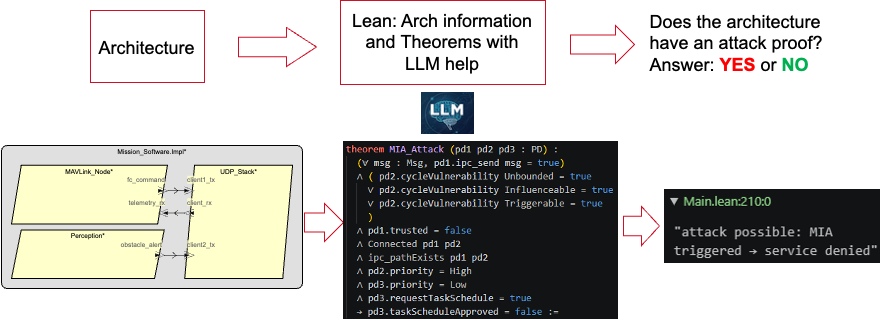
Through summer internships at Collins Aerospace, contributes to formalizing attacks in the Lean theorem prover and to explainable assurance cases.
Figures
Demos
Three simulated drones in Gazebo maneuver around one another using their neighbors' broadcast positions. This is the cooperative behavior that Remote ID spoofing targets, and that spoofing-aware planning protects.
Dozens of simulated vehicles launched in a single experiment, showing how the simulator scales for cyberattack studies.
Simulated drones, each linked to its own operator’s ground control station, as in the multi-operator setting of the FAA UTM concept of operations.
Vanderbilt’s networked simulator flies many drones from multiple operators over a downtown map, each running its own ArduPilot autopilot. It’s the platform used to generate attack datasets and evaluate detectors.
Use cases
Detecting falsified Remote ID broadcasts from the physics of the radio signal, and planning safe paths around suspected spoofers.
An aircraft broadcasting false position and velocity to hide its intent or manipulate nearby aircraft.
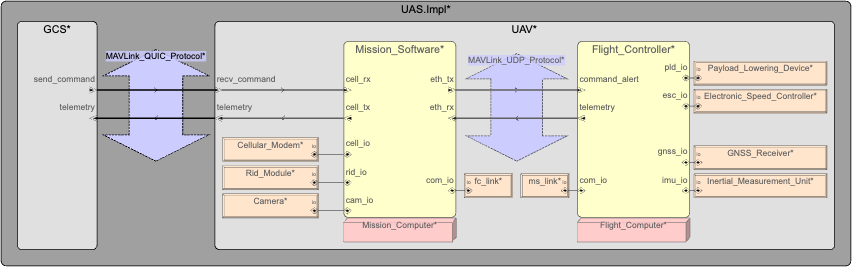
Evaluating and hardening the MAVLink link between ground control stations and drones, and detecting hijacked vehicles.
Interception, command injection, and telemetry spoofing on unauthenticated control links.
Coordinating flight plans, sequencing, and resources among self-interested operators without a single point of failure.
Compromised coordinators, strategic misreporting, collusion, and spoofed arrival information.
Building drone software architectures with zero-trust patterns, and proving whether attacks are possible with a theorem prover.
Vulnerabilities that propagate between untrusted components of drone and ground-station software.
People
Publications
8 published or accepted papers
AIAA SciTech Forum, 2026
AIAA SciTech Forum, 2026
GNU Radio Conference, 2026
AIAA SciTech Forum, 2026
AIAA SciTech Forum, 2026
AIAA SciTech Forum, 2026
AIAA/IEEE Digital Avionics Systems Conference (DASC), 2026
International Workshop on Explainability of Real-time Systems and their Analysis (ERSA), IEEE RTSS, 2025